I’ve written before about my growing collection of laserdiscs, and the generosity of a friend who lent me their ‘backup’ player so I could actually start watching these 12-inch odes to analog cinema.
I’ve really enjoyed spending time with movies in this format. Since the discs themselves can only hold a maximum of 60 minutes or so of video per side, there’s a natural break point while viewing that requires me to get up and either flip the disc over, or just turn off the TV. More often than not, I do the latter, as it allows me to get through older movies in easily digestible chunks that fit around my schedule, instead of requiring me to carve out a full sitting. As most of the movies I have on laserdisc I’ve already seen, this works out quite well for casual viewing.
Still, there was one aspect of the laserdisc experience that was lacking. Standard-def video, especially as interpreted by my early-80s Pioneer player, does not look great on a high-definition LCD television. Laserdiscs output at around 435i, which is just below the 480i resolution of a traditional DVD. It was tolerable at first when I was using a very small display that I had previous tagged in for retro gaming, but when I moved up to a 720p, 32-inch display, I started to run into issues with brightness, background waviness, and other artifacts that were intruding into the picture.
Online research revealed that I had two choices: invest in a complicated, and expensive, series of upscaling devices, or switch to a CRT. I haven’t owned a cathode ray television set since 2011, but it turns out they are extremely cheap to buy, even for models that were considered higher end back in the day. They’re also a lot simpler to deal with from a setup perspective, as long as you have the space to accommodate their considerable bulk.
I mentioned my CRT hunt to my father, who told me he had a 25-inch unit in storage that he had been planning to sell at a garage sale. I picked it up in early April, and discovered that it only had a coax RF input, with no RCA plugs at all, an unusual feature for a TV from the 90s but one that I could theoretically work around given my boxes and boxes of cables and converters that I have stubbornly moved from one house to another over the decades (does anyone else have a similar collection of obsolete electronic gear trailing them ‘just in case’ they need it one day?).
Then, a plot twist: a week after I had the new-to-me CRT at home, I stumbled across an ad on Facebook Marketplace for a 32-inch Sony Trinitron WEGA. I had been casually searching for a Trinitron since I got the CRT bug, as they are still highly respected displays. The price? A mere $20, which seemed too good to be true (I often see them trading in the $100 to $150 range).
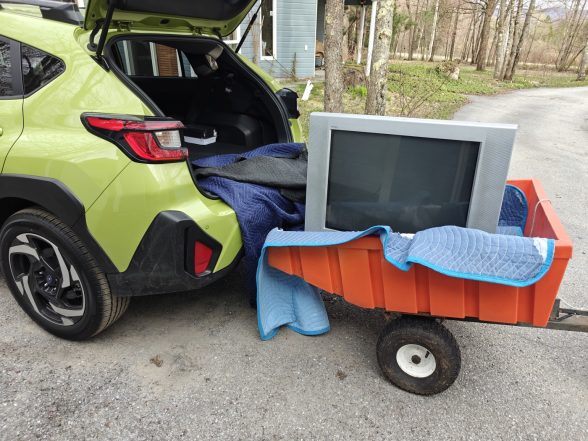
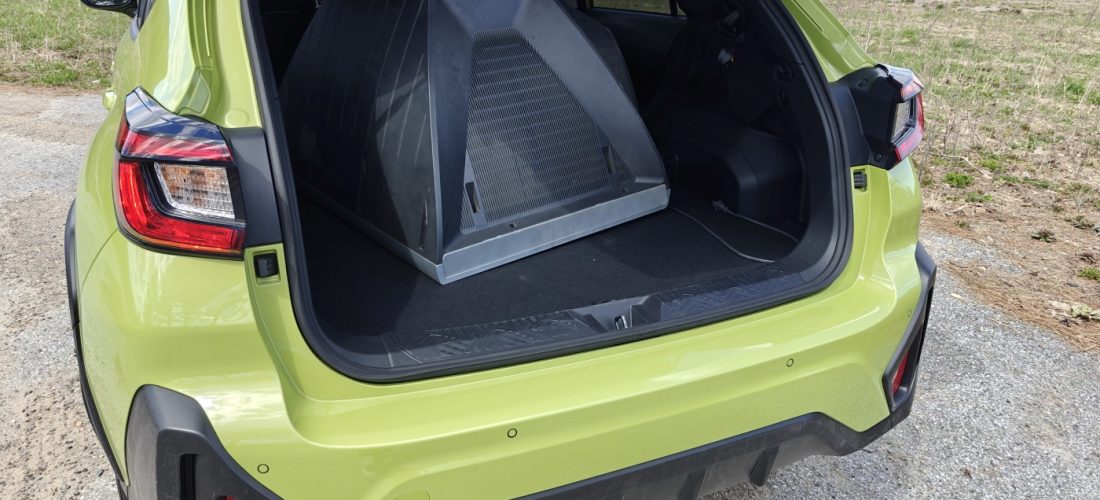
After some phone tag, I was able to pick up the Trinitron in Montreal and cart it back to my rural home. I had forgotten just how massive large screen CRTs truly were. Even face-down, sitting on its frame, the Sony took up the entire cargo area of the Subaru Crosstrek I was driving. On top of that, it weight nearly 180 pounds, which made loading it and unloading it an adventure (requiring me to tag in my tractor and trailer to cart it to my garage for temporary storage).

Once I had located a TV stand that could handle the weight of the Trinitron, courtesy of a local woodworker, my wife and I used not one, but two dollies to schlep it from the garage to the house, eventually depositing on the stand in our spare bedroom. I won’t lie: there was a moment during the lift up from the dolly to the stand where I was concerned my wife, who is of modest stature, was going to be crushed beneath the Sony’s awkward bulk, but fortunately we both survived.
Un-crushed and excited to get everything all hooked up, the next step was to hook up my laserdisc player and see if the entire struggle had been worthwhile. As it turns out, having a CRT in the house again had an impact on more than just my LD-watching habits—but I’ll get into that in part 2 of my old school TV journey.