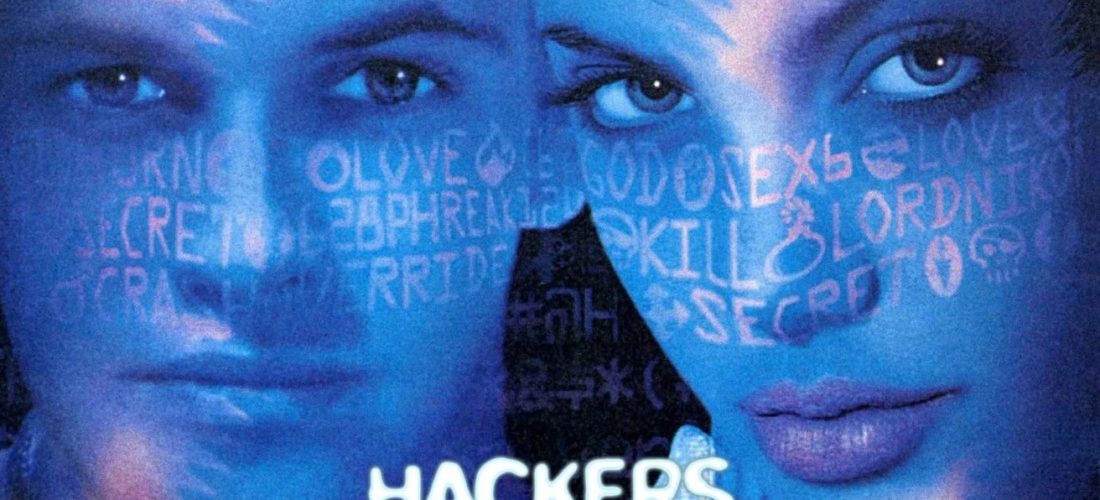
Let me get this out of the way: I love the movie Hackers. Its inclusion in this series about bad movies with great soundtracks is about evaluating whether or not it’s a successful film, not its status as a fantastic document of what a very specific group of extremely creative people in both London (shout-out to British director Iain Softley and the flick’s many UK locations) and Hollywood thought the world of computer hacking was like in the 1990s.
As a cultural touchstone, Hackers is unassailable, a perfect distillation of trends and acting talent that captures a snapshot of a moment in time that is no less important for existing only in our imaginations of that era. As a movie, on the other hand, it’s heavily reliant on the healthy dollop of style and flash smeared all over the lens to disguise the failings of the script (and the technical illiteracy of its plot).
That duality is reflected in the relative indifference of filmgoers to Hackers’ charms when it was released in 1995—and its ascendance to cult classic status in the years since then. A big part of that re-evaluation of the movie rests on the shoulders of its second-most enduring contribution to pop culture (after its fashion, of course): its soundtrack.
The Deepest Pool Of 90s Electronic Music Assembled To Date
The previous entry in this series covered The Saint, which offered a heavy dose of in-the-moment electronic music of the 1990s. Hackers did something very similar, but two years earlier than the Val Kilmer vehicle, and with a much deeper draft.
There’s some stylistic crossover between the two albums, including tracks from The Prodigy (Voodoo People, One Love) and Underworld (Cowgirl).
That being said, Hackers went well past the ‘electronica’ that was starting to escape clubs and raves and climb onto the pop charts. There’s work here from Leftfield, Carl Cox, and Kruder & Dorfmeister, all tunes that you’d have to put in work to be familiar with in North America before this soundtrack dropped.
The best-known entry for those who weren’t already listening to trance, house, and breakbeat-inflected music was probably Connected from the Stereo MC’s (long a favorite listen of mine), which had been a top 20 hit in the United States three years beforehand.
And yet, in contrast to the Stereo MC’s colonizing the Hot 100, the tune that had the biggest impact on Hackers fans at the time, and which remains tip-of-the-tongue when discussing the soundtrack today, is the one that was perhaps the farthest from a mid-90s mainstream audience: Orbital’s Halcyon On and On, a nine and a half minute slow burn that also found its way into same-era celluloid like Mortal Kombat.
The Hackers Soundtrack Was A Triple Threat
The decision to link a movie about computer hacking with, well, music produced by computers was an inspired bit of artistic synergy that paid massive dividends for the movie’s marketing team. How many other films have been able to release not just one, but two sequel soundtrack albums (the creatively named Hackers 2 and Hackers 3)?
Even better is that instead of opening up the sales floodgates and cramming these CDs with mainstream appeal, the Hackers crew tripled down on the philosophy that guided the original album.
Sure, you’ll find Moby’s “Go,” as well as Brooklyn Bounce’s “Get Ready To Bounce,” but there’s also rabbit hole beckoners like Empirion (Narcotic Influence 2), The Orb (Toxygene), Cirrus (Stop and Panic), Fluke (the excellent Absurd), and multiple tracks from BT (Godspeed and Remember). Even the composer of the Hackers score, Simon Boswell, also got a couple of his recordings squeezed onto the end of the third disc.
There are 42 tracks in total spread across the trio of Hackers soundtrack releases (14 per CD). I’m not going to go through all of them here, but I do want to point out that it’s interesting to see David Bowie’s Little Wonder (the Danny Saber mix, again) appearing here year prior its inclusion with The Saint.
As if that wasn’t enough, in 2020 yet another iteration of the Hackers soundtrack became available. This 25th anniversary celebration gathered up the best of the original release, and added Massive Attack’s Protection (strangely left every other album, despite being prominently featured in the movie), as well as much more of Boswell’s original score.
Softley Was Early With Electronic Music In North America
Peer into director Softley’s past, and you’ll find that he came to Hackers immediately after another music-soaked strip of celluloid, Backbeat, the fantastic (and under-seen) biopic of the Beatles. It’s no surprise that soundtracks were an important aspect of his creative process, and he’s discussed how the selections were culled from a pool of his own listening, suggestions from his assistant, Gala Wright, and music supervisor Bob Last making sure they had at least a few more prominent names to pull people into record stores.
Softley had to fight with the studio to keep his electronic audio ‘cyber hallucination’ in the movie. Quite rightly, executives pointed out that dance music, particularly trance and breakbeat, had no traction with American audiences, and pushed him to embrace the alt rock standards of the day. They didn’t realize Hackers was ahead of its time, if not in terms of technology or storytelling, then definitely regarding what burrowed its way into our ears. We’re lucky he held his ground and delivered this stealth masterpiece of musical accompaniment.